
Articles
See All
TURNAROUND TIME FOR HLS THERAPUTICS
**Claude and me wrote this story**
It is TURNAROUND time for HLS Therapeutics, HLS-TSX. Most of the heavy lifting has been done—new management, big debt paydown, new drugs ready to hit their sales channels. Growth is upon us.
THEY REPORT NEXT WEEK, NOV 12. THEY REPORT IN USD AND THEIR (FAST REDUCING) DEBT IS IN USD
This small cap has a VERY tight float—two funds own 38% of the 30 million shares out. And the one other big negative—operating management, there since 2023, owns essentially no stock. But the operating leverage on these two new drugs is really interesting to me, so I own a “fun” (read-small) amount of stock and will watch the story for the next 6-9 months.
For three years, HLS Therapeutics spent almost every spare dollar paying down debt. That job is now mostly done. Debt fell from about 3.5 times yearly cash profit in early 2024 to 1.5 times by mid-2026. Yearly interest fell from US$8.5 million to US$3.2 million. The cash that once went to lenders can now go to growth.
The growth comes from two new cholesterol pills, NILEMDO and NEXLIZET. HLS sells them through the heart-drug sales team it already pays for. So each new dollar of sales costs little to win, and most of the profit drops to the bottom line. An old schizophrenia drug, Clozaril, keeps paying the bills while the new drugs grow.
After 3 years of balance sheet repair, this turnaround is in like the 4th inning. Sales grow slowly in 2026. The real test comes in 2027, when provincial drug plans should start paying for NILEMDO and NEXLIZET should reach the market.
If both go well, cash profit (adjusted EBITDA) could climb from about US$19 million this year to US$23–35 million by 2028. With the operating leverage of an existing sales force, that could work out to roughly C$1.05–1.58 a share, against a C$4.33 share price. “The profit engine” below shows the math.
Key numbers at a glance
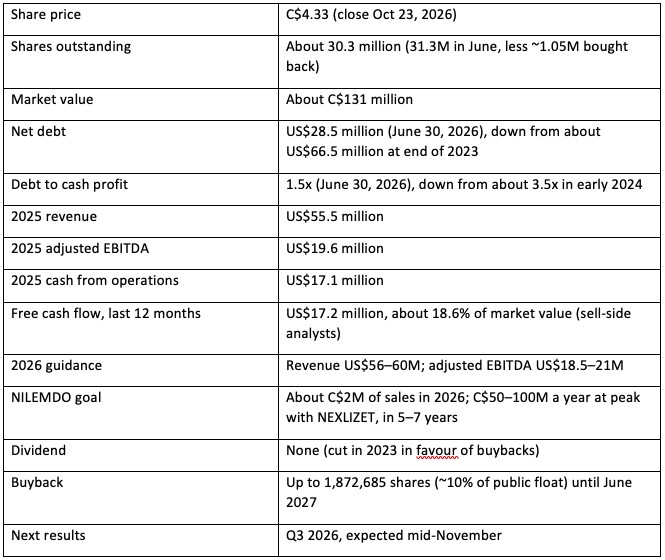
The case in one paragraph each
Why it could work. NILEMDO is off to the fastest start of any drug HLS has launched. Doctors put nearly 1,200 patients on it by the end of June, about 3.5 times Vascepa’s pace at the same point. Private plans covering about 80% of privately insured Canadians now pay for it, mostly with no paperwork. Canada’s Drug Agency voted unanimously for public coverage, and price talks with the provinces start this fall. NEXLIZET should get a Health Canada decision by year-end. The same reps carry all of these heart drugs, so costs barely rise as sales do.
Why it could disappoint. Sales start from a tiny base: about C$2 million of NILEMDO this year. Provincial price talks could drag on or force a lower price. Clozaril still earns more than the whole company’s cash profit, and it slowly loses ground. HLS once promised far too much for Vascepa, and the market has not forgotten. Two hedge funds own about 38% of the shares, and the stock trades thinly.
All figures are in U.S. dollars unless marked C$. Market value and share count after buybacks are estimates, using roughly 1.38 Canadian dollars per U.S. dollar.
The story in four chapters
HLS’s history explains both its cheap share price and its upside. The company grew on borrowed money, stumbled, fixed itself, and now turns to growth.
Chapter 1: A cash cow and borrowed money (2015–2019)
HLS started in 2015 with a smart idea. It bought the U.S. and Canadian rights to Clozaril, an old but vital schizophrenia drug, plus royalty streams on other companies’ drugs. Together they threw off about US$11 million of free cash in 2019. HLS borrowed to buy them, and it paid a dividend too. In 2017 it licensed Vascepa from Amarin to give itself a growth drug.
Chapter 2: The big promise that went wrong (2020–2023)
HLS launched Vascepa in Canada in early 2020, just as COVID shut doctors’ offices. Worse, the old management team told investors Vascepa could reach C$250–300 million a year in sales. Today’s managers believe that big number scared the provinces’ price negotiators into strict limits on who could get the drug. Sales grew far more slowly, and Vascepa lost money for years.
At the same time, royalty income ran dry. Royalties once made up about half of HLS’s cash profit; one expired and HLS sold another. The debt stayed. The stock fell about 70% over five years.
Chapter 3: The repair (2023–2026)
In 2023 a large shareholder, Polar Asset Management, pushed for change. The founder retired and Craig Millian became CEO. The new team cut the dividend, dropped a money-losing drug and ended a costly sales deal with Pfizer. It rebuilt its own heart-drug sales team. It sold a royalty and used that cash, plus its own cash flow, to repay about US$39 million of debt in two years.
The results show up in every number. Leverage fell from about 3.5 times to 1.5 times. Interest fell from US$8.5 million a year to US$3.2 million. The cash left over after interest, which management calls “capital available for allocation,” grew from about US$3 million a year to almost US$15 million. HLS did this while losing more than US$9 million a year of royalty profit.
Chapter 4: Growth, paid for with cash (2026 onward)
Now the cash goes to work. HLS licensed NILEMDO and NEXLIZET from Esperion in 2025 for just US$2 million up front. It launched NILEMDO in spring 2026 without hiring a new sales force. The CEO now ranks debt repayment third, behind growth and buybacks. “If I had given this talk two years ago, debt repayment would have been number one, two and three,” he told investors in October.
The question for 2027 and 2028 is simple: how fast do the new drugs grow, and how much of each new dollar reaches the bottom line?
What HLS does
HLS Therapeutics buys or licenses drugs that other companies invented, then sells them in Canada and the U.S. It does not run labs or factories. It owns brands, sales teams, and patient-support programs, and pays outside firms to make the pills.
The company formed in 2015 and is based in Toronto. It works in two areas: mental health (psychiatry) and heart health (cardiovascular, or CV). HLS reports in U.S. dollars, but most of its sales happen in Canada in Canadian dollars. All dollar figures below are US$ unless marked C$.
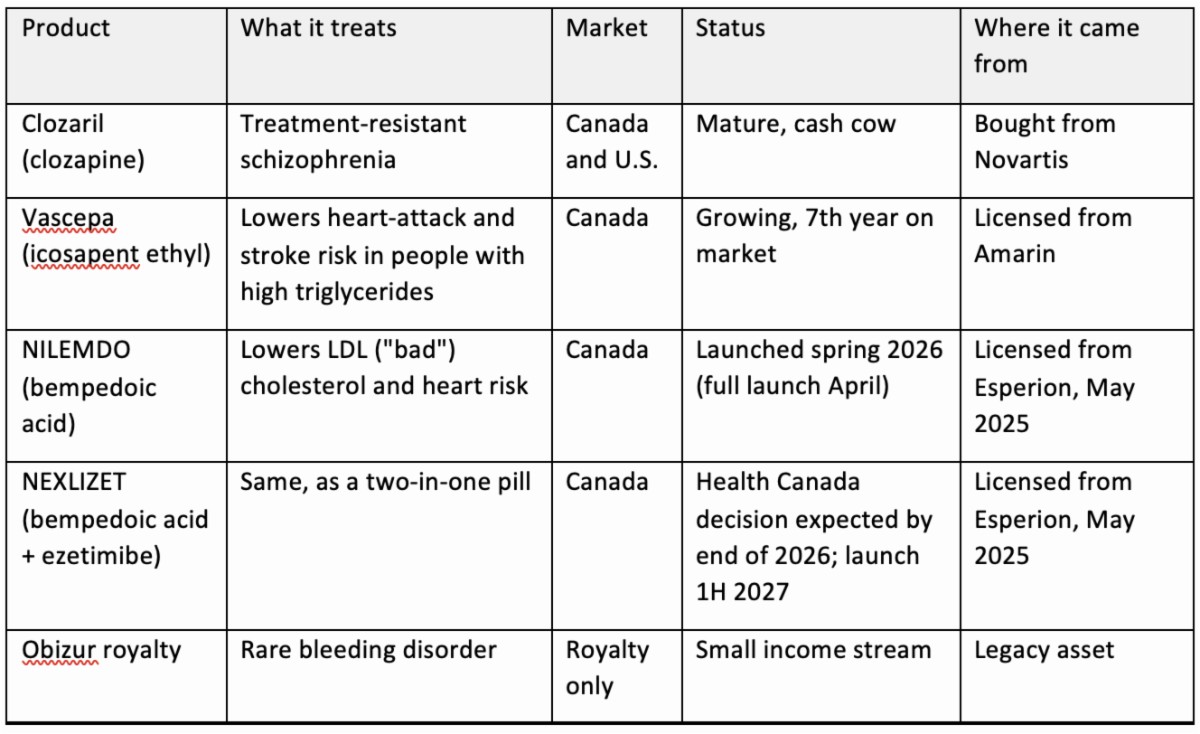
The product line-up
How HLS sells
HLS has three distinct sales channels:
1. The Canadian cardiovascular sales team. These reps call on family doctors, cardiologists and internists. HLS rebuilt this team in 2025. Today it sells Vascepa and NILEMDO to the same doctors on the same visits. NEXLIZET will join the same bag in 2027. Each new product adds revenue without adding many new people.
2. The Clozaril patient-support network in Canada. Clozapine can cause a dangerous drop in white blood cells, so every patient needs regular blood tests. HLS runs a monitoring and support system for this. Doctors, pharmacies and patients plug into it, which makes Clozaril “sticky” even against cheaper generics.
3. A U.S. specialty pharmacy program for Clozaril. HLS uses specialty pharmacies to keep U.S. patients on brand Clozaril. This program slowed the U.S. decline to 1.6% in 2025, from an average of 6% a year over the prior four years.
The key idea: HLS already pays for a national heart-health sales force. Every extra heart drug it adds rides on that same cost base. That is why management and analysts talk about “operating leverage.”
The Four Products
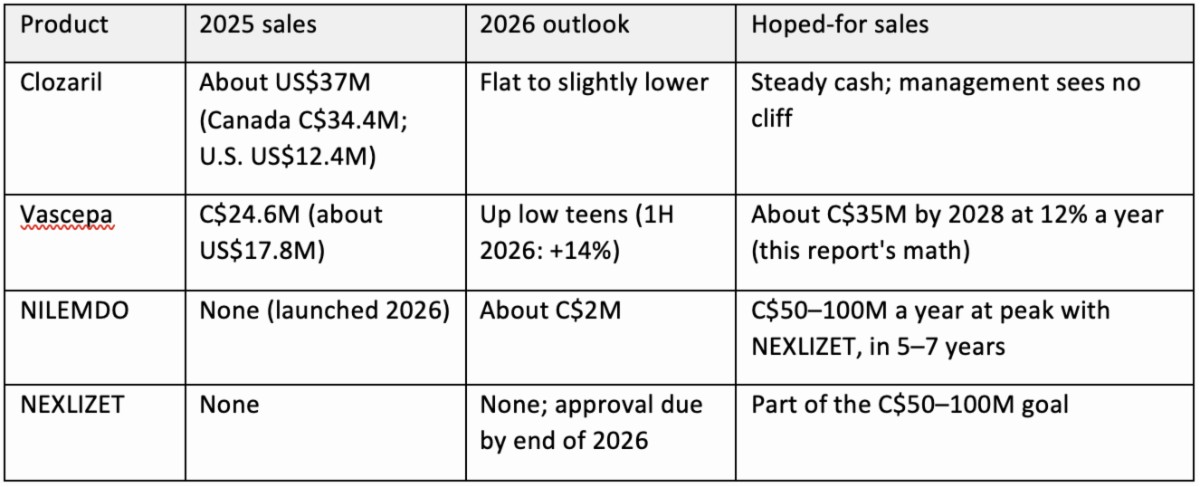
HLS has one cash cow, one steady grower and two new launches. Here is what each drug does, what it earns now, what management hopes it will earn, and what to watch in the next 12 months.
Clozaril: the cash cow that funds everything
Clozaril (clozapine) treats schizophrenia that has not responded to other drugs. It belongs to the only drug class approved for this group. Many of these patients have tried ten or more drugs and run out of options.
Features and benefits
- Works when nothing else does. Canadian guidelines name clozapine as the treatment for treatment-resistant schizophrenia.
- A built-in moat. The drug can cause a dangerous drop in white blood cells. Patients need 39 blood tests in their first year, and Health Canada requires each maker to run a patient registry.
- CSAN and CSAN Pronto. HLS’s registry tracks each patient’s blood results for doctors and pharmacists. Its Pronto finger-prick device gives a white-cell count in minutes at the clinic. Pronto works only with brand Clozaril.
- Loyal patients. Stable patients rarely switch. Most of the patients HLS loses die of other causes.
Sales now. Clozaril brought in about US$37 million in 2025, about two-thirds of it in Canada. It still holds about 50% of the Canadian clozapine market after 20 years of generics. It earned about US$27 million of direct profit in 2025, more than the whole company’s adjusted EBITDA. That profit covers head office and funds the heart-drug launches.
Sales hoped for. Management does not expect a cliff. It aims for flat to slightly lower Canadian sales. Fewer new patients in Quebec and tough hospital pricing in Ontario should be offset by gains in the West, where B.C. patients grew 11%. U.S. sales should stay roughly flat. The Canadian patient count grew five months in a row through July.
Next 12 months. Watch monthly patient counts, Ontario hospital contracts, and any Health Canada review of blood-test rules. The U.S. scrapped its mandatory monitoring program in 2025.
Vascepa: the slow starter, still growing in year seven
Vascepa (icosapent ethyl) is a highly purified fish-oil pill. It cuts heart-attack and stroke risk in people with high triglycerides who already take a statin.
Features and benefits
- Proof most drugs lack. In the REDUCE-IT trial, Vascepa cut heart attacks, strokes and heart deaths by 25% on top of statins. It cut heart deaths alone by 20%, a rare result for any heart drug.
- First and only in its class. No other drug in Canada carries this label.
- Long protection. Patents protect it in Canada until about 2039.
- Wide coverage. Plans covering more than 95% of eligible Canadians pay for it. The catch: public plans cover only patients who already had a heart event, and about half of private patients need prior approval.
Sales now. Canadian sales reached C$24.6 million in 2025 (about US$17.8 million), up 9%. In the first half of 2026, sales rose 14% on 17% more units, faster than in 2025. Q2 alone grew 18%. Vascepa earned a US$1.0 million direct profit in 2025, after losing US$3.6 million in 2024.
Sales hoped for. Management expects growth in the low teens from here. At 12% a year, Vascepa would reach about C$35 million in 2028. That is a fraction of the C$250–300 million old management once promised, but it is real, growing and profitable. NILEMDO helps: reps who had little new to say about Vascepa now get in the door with NILEMDO, then use the rest of the visit on Vascepa.
Next 12 months. Quarterly growth in the low teens; more new patients as NILEMDO visits lift Vascepa; public plans’ share of sales holding near 50–55%.
NILEMDO: the growth engine
NILEMDO (bempedoic acid) is a once-a-day pill that lowers LDL, the “bad” cholesterol. It blocks cholesterol-making in the liver one step before statins do. HLS licensed the Canadian rights from Esperion in May 2025 and launched in spring 2026.
Features and benefits
- A first It is the only oral non-statin approved both to lower LDL and to cut heart events. The CLEAR Outcomes trial, with about 14,000 patients and published in the New England Journal of Medicine, showed fewer heart attacks and other major heart events.
- Easier on muscles The drug switches on in the liver, not in muscle. So it avoids much of the muscle pain (myalgia) that makes many people quit statins.
- Fills a gap Patients who can’t take statins, or can’t reach their goal on them, have one step up today: PCSK9 injections. Those cost C$15–20 a day and are so hard to get that they hold about 1% of the market. NILEMDO lists at C$4.25 a day.
- Saves payers money Insurers see NILEMDO as a cheaper pill that offsets injection costs, not as a new cost on top. That is the key difference from Vascepa.
- Flexible Doctors can use it alone or with other cholesterol drugs. It cuts LDL about 19% on its own.
- Protected for years Data protection blocks generics until late 2033, and pending patents could extend protection to 2040.
- Cheap to acquire HLS paid US$1 million at signing and US$1 million on approval. It owes royalties and milestones of up to about US$5 million.
Sales now. NILEMDO sold C$456,000 in the first half of 2026. Doctors started nearly 1,200 patients by the end of June, about 3.5 times Vascepa’s pace at the same point. That came before most private coverage was in place. Private plans covering about 80% of privately insured Canadians now pay for it, most with no prior approval. Management expects about C$2 million of sales in 2026.
Sales hoped for. HLS counts about 5 million Canadians with heart disease or high heart risk. About 3 million take statins. About 500,000 of those can’t reach their goal on statins plus ezetimibe, or can’t tolerate statins. Reaching 10–20% of them would bring in C$50–100 million a year within five to seven years, for NILEMDO and NEXLIZET together. Sell-side analysts model a much slower path: 5% of patients after eight years.
Profit per sale. Management expects about a 65% gross margin after Esperion’s supply price and royalties. It plans no big jump in spending in 2027. So most new gross profit should drop straight to cash profit.
Next 12 months. Price talks with the provinces (pCPA) start this fall and should end by year-end. First provincial listings should follow in the first half of 2027. About 70% of this market sits on public plans, so this is the key step. Also watch Q3 and Q4 sales against the C$2 million goal.
NEXLIZET: the two-in-one follow-up
NEXLIZET combines bempedoic acid with ezetimibe, an older generic cholesterol pill, in one tablet.
Features and benefits
- Twice the punch. It cuts LDL about 38%, double NILEMDO alone, in a single pill.
- Built-in demand. Many patients already take ezetimibe. Doctors can swap two pills for one.
- Same doctors, same reps. It adds sales with almost no new cost.
- Same protection as NILEMDO.
Sales now. None. Health Canada turned back the first filing in November 2025 over manufacturing data. It raised no concerns about safety or how well the drug works. HLS and Esperion answered in Q2 2026.
Sales hoped for. Its sales count inside the C$50–100 million peak goal. The CEO calls 2027, with NEXLIZET on the market, “an inflection point in terms of growth.”
Next 12 months. A Health Canada decision by the end of 2026, then a launch in the first half of 2027. After launch, expect the same path NILEMDO took: private insurers first, then the public review and price talks.
The profit engine: what 2027 and 2028 COULD look like
HLS’s costs are mostly fixed, so profit should grow much faster than sales. In this report’s middle case, revenue rises about 31% from 2026 to 2028, while cash profit (adjusted EBITDA) rises about 54%.
The reason is the shared sales team. The same reps sell three, then four heart drugs to the same doctors. Management expects about a 65% gross margin on NILEMDO, plans no big spending increase in 2027, and sees room for operating margins of 35–40% once the heart business reaches scale. “Our revenues will vastly outpace our opex,” the CEO told investors in October.
How the math works
- Starting point: 2026 revenue of US$58.4 million and adjusted EBITDA of US$19.0 million. Sell-side analysts forecast US$58.2 million and US$18.9 million.
- Clozaril shrinks 1–3% a year. Each lost dollar costs about 73 cents of profit, its 2025 profit ratio.
- Vascepa grows 10–13% a year. Management expects low-teens growth.
- NILEMDO plus NEXLIZET sell C$6–15 million in 2027 and C$11–35 million in 2028. Management’s goal implies about C$1,000 of sales per patient per year (10% of 500,000 patients = C$50 million). So 2028 sales mean 11,000 to 35,000 patients, or 2–7% of the market. That is well short of management’s 10–20% peak.
- New heart-drug sales keep 65 cents of gross profit per dollar.
- Spending rises US$0.5–1 million in 2027 and US$1–2 million in 2028.
- US$1 = C$1.38; about 30.3 million shares.
Three cases (US$ millions unless marked)
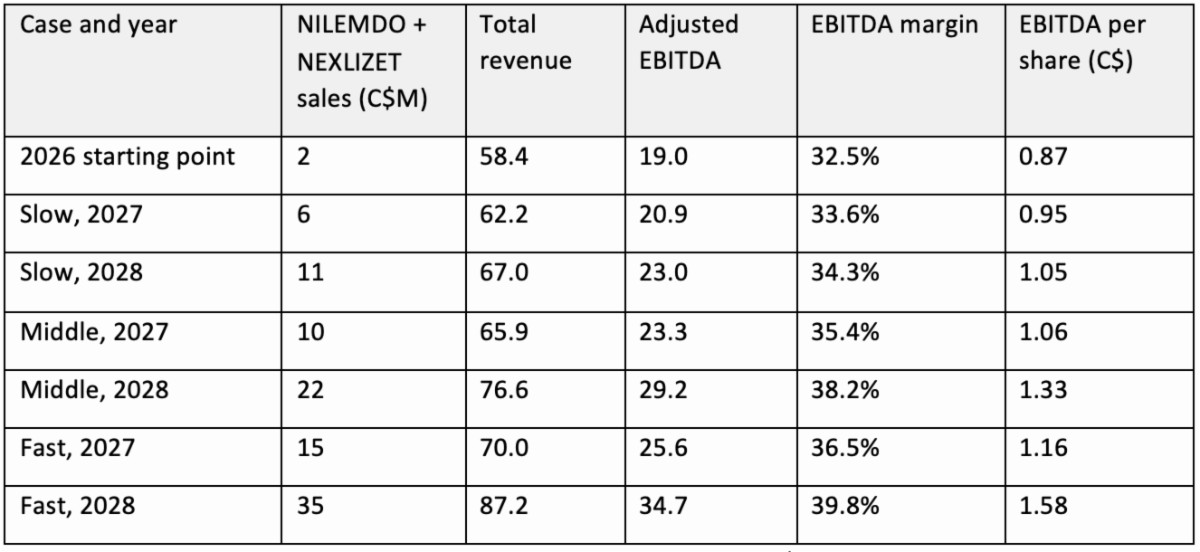
The slow case looks like sell-side analysts’ models, which forecast US$62.8 million of revenue and US$22.2 million of EBITDA in 2027. The middle case follows the path management describes. The fast case assumes quick provincial listings and a strong NEXLIZET launch.
What it means per share
Cash profit is not cash in hand. Take off interest (about US$2–2.5 million) and a rough US$1 million for taxes, and here is what HLS could have left to spend in 2028:
At C$4.33 a share, the middle case puts about C$1.19 a share of free cash in HLS’s hands in 2028, more than a quarter of today’s share price in a single year. The 6.2x multiple is in line with specialty-drug peers. 8x sits near HLS’s own long-term average of about 8.2x. Both values assume net debt of about US$25 million.
What the cash would pay for. Management ranks its uses: first, growth, through licensing deals of up to about US$30–35 million with small upfront payments and no new shares (it would take debt to 2.5–3 times for the right deal); second, buybacks; third, debt. It also says a merger could be a faster path to its goal of US$100 million or more in revenue.
Caveats. These figures are this report’s illustrations, not forecasts. They leave out new deals, Esperion milestone payments and currency swings. Accounting profit will stay near zero for a while: Sell-side analysts expect roughly breakeven earnings per share in 2027 because of about US$22 million a year of non-cash amortization.
Catalysts by product: the next 12 months
Five big events in the next 12 months will show whether the turnaround is real, and the first three land within about two months. The CEO says investors will feel their impact “in weeks, in some cases months, not years.”
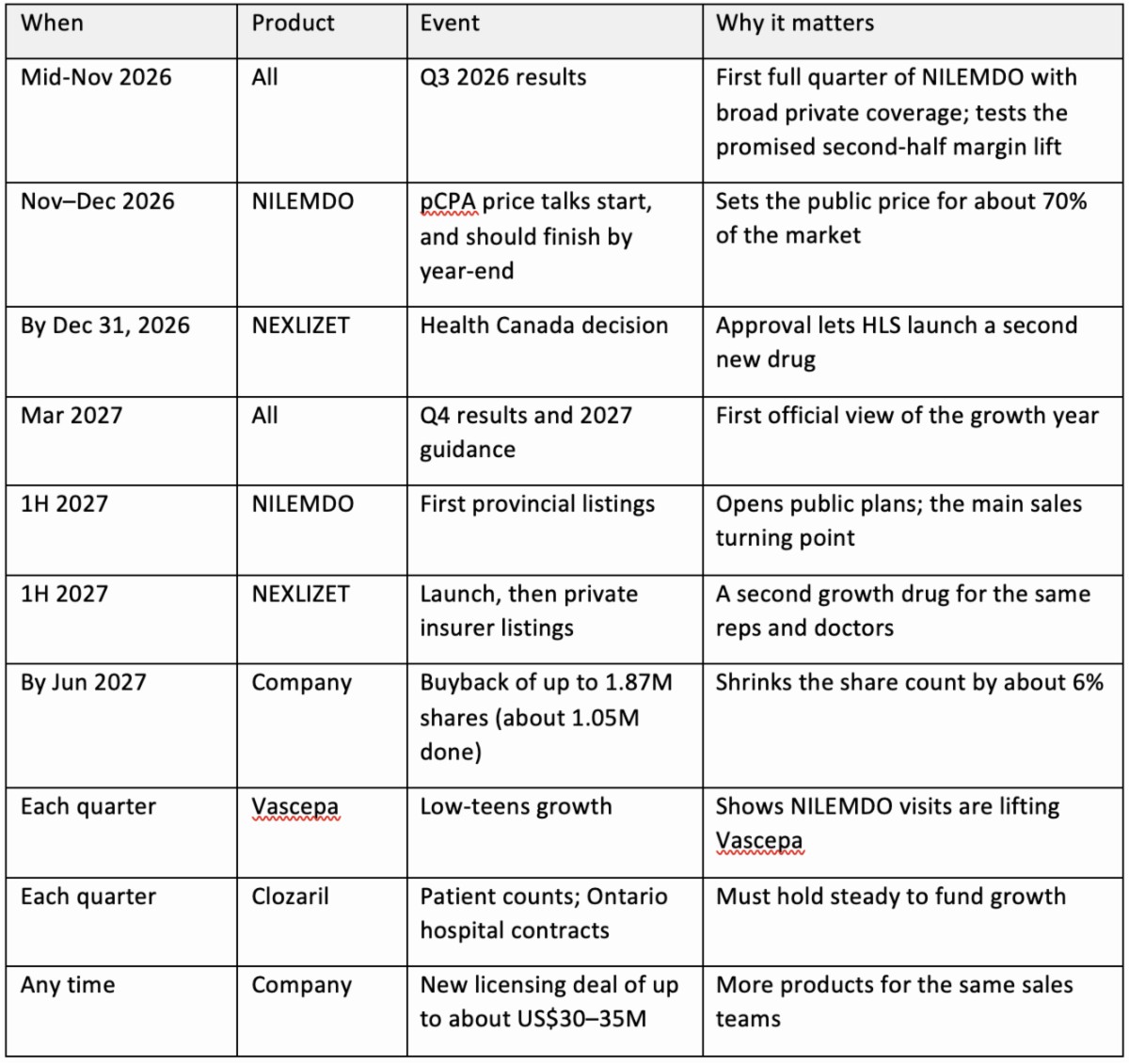
The chart below shows the company’s own milestone dates from the Esperion deal through mid-2027.
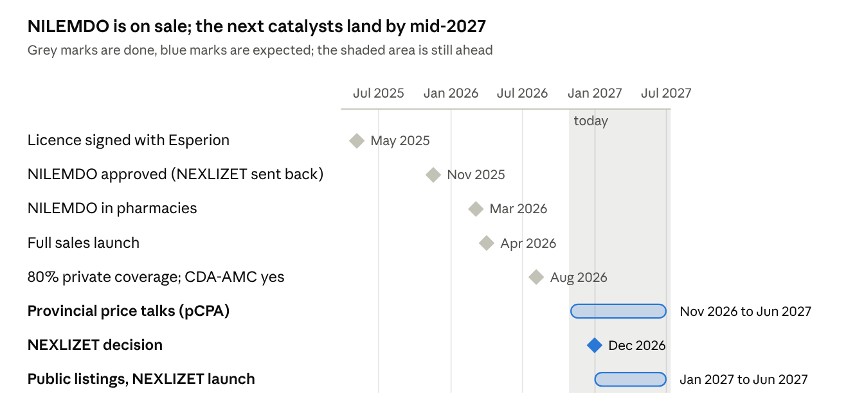
HLS releases · May 2025 to mid-2027 · future dates are company targets
Financials
HLS makes real cash but shows an accounting loss. The loss comes mostly from a non-cash charge: about US$22 million a year of amortization, which writes down the cost of drug rights HLS bought years ago. Strip that out and the business generates steady cash.
Results by year (US$ millions)
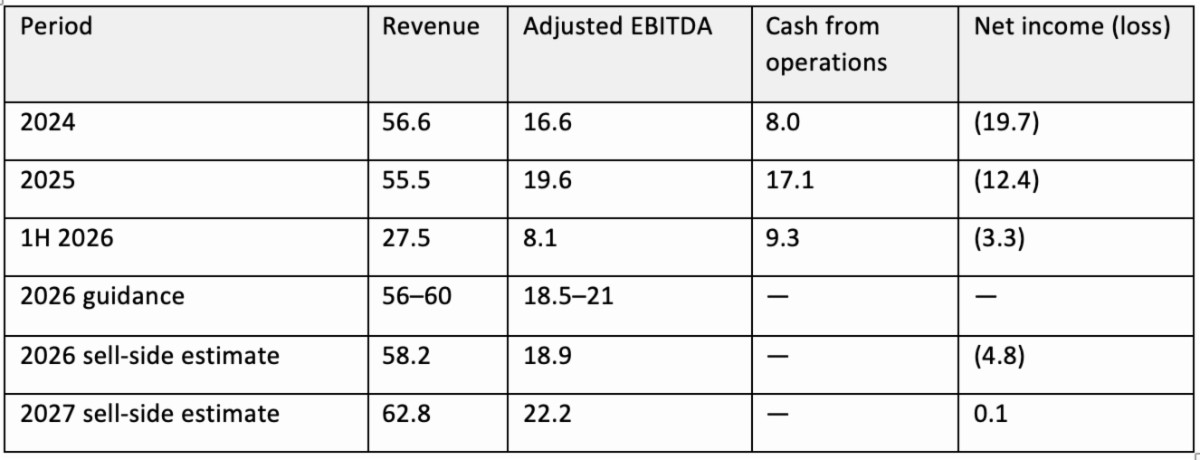
A few points stand out:
- Revenue is flat, profit is up. Revenue slipped in 2024 and 2025, partly because HLS sold a royalty stream (Xenpozyme) in 2024 and partly because of currency. Yet adjusted EBITDA rose 18% in 2025, because HLS cut operating costs 17%.
- Cash flow doubled. Cash from operations jumped 114% in 2025 to US$17.1 million. Lower interest costs drove much of that.
- 2026 is an investment year. Guidance calls for flat adjusted EBITDA because of NILEMDO launch costs. Management expects margins to widen in the second half as NILEMDO sales build. Q4 is usually the strongest quarter.
- Losses are shrinking. The net loss narrowed from US$19.7 million in 2024 to US$12.4 million in 2025, and to US$3.3 million in the first half of 2026.
Debt: the big turnaround
HLS has cut its net debt by more than half since the end of 2023. It repaid US$21 million in 2024 and US$17.8 million in 2025. In 2025 it also refinanced with a new lender on better terms. Interest expense fell 43% in 2025. In the first half of 2026 interest cost only US$1.3 million, versus US$3.1 million a year earlier.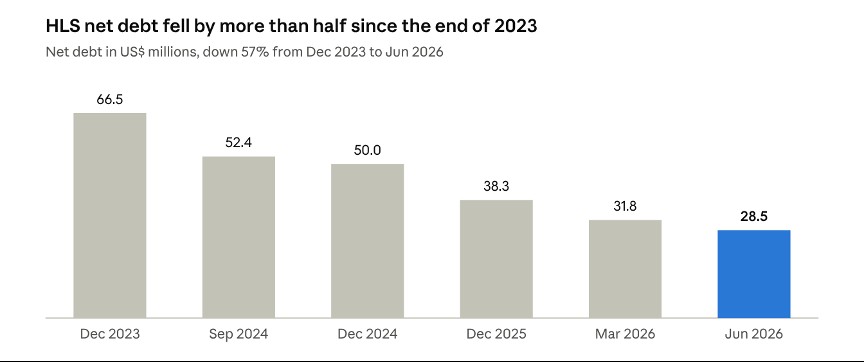
HLS quarterly and annual releases · Dec 2023 to Jun 2026 · Mar 2026 is approximate (17% below year-end 2025)
At June 30, 2026, HLS owed US$42.2 million on its term loan and held US$13.7 million in cash. Leverage fell to 1.5 times cash profit, from about 3.5 times in early 2024. Interest paid over the past year fell to US$3.2 million, from a peak of US$8.5 million in 2024. Management’s measure of spare cash, adjusted EBITDA less royalty income and interest, rose to US$14.7 million from US$3.1 million at the start of 2024.
Management says the heavy lifting on debt is done. It no longer makes extra debt payments beyond what the loan requires. Instead it is shifting cash toward new products and buybacks.
Buybacks
HLS cancelled the dividend in 2023 and started buying back shares instead. Under the current program it can buy up to 1,872,685 shares (about 10% of the public float) until June 24, 2027. It raised that limit in September 2026, the maximum the TSX allows. By late September it had bought back about 1.0 million shares at an average price near C$3.90, according to sell-side analysts.
What the market pays today
These are rough estimates, at C$4.33 a share:
- Market value: about C$131 million (about US$95 million).
- Enterprise value (market value plus net debt): about C$170 million (about US$123 million).
- Enterprise value to 2026 adjusted EBITDA: about 6.2 times, using the guidance midpoint of US$19.75 million.
- Cash from operations versus market value: 2025 operating cash flow equals about 18% of today’s market value.
Sell-side analysts’ forecasts put HLS at about 6.4 times its 2026 EBITDA and 5.4 times 2027, below a peer median of about 7.4 and 7.0 times. Four sell-side analysts cover the stock.
Ownership: insiders and institutions
Two hedge funds control the register; management owns very little. Stadium Capital and Polar Asset Management together hold about 38% of the shares. Officers and directors own less than 1%.
Largest holders
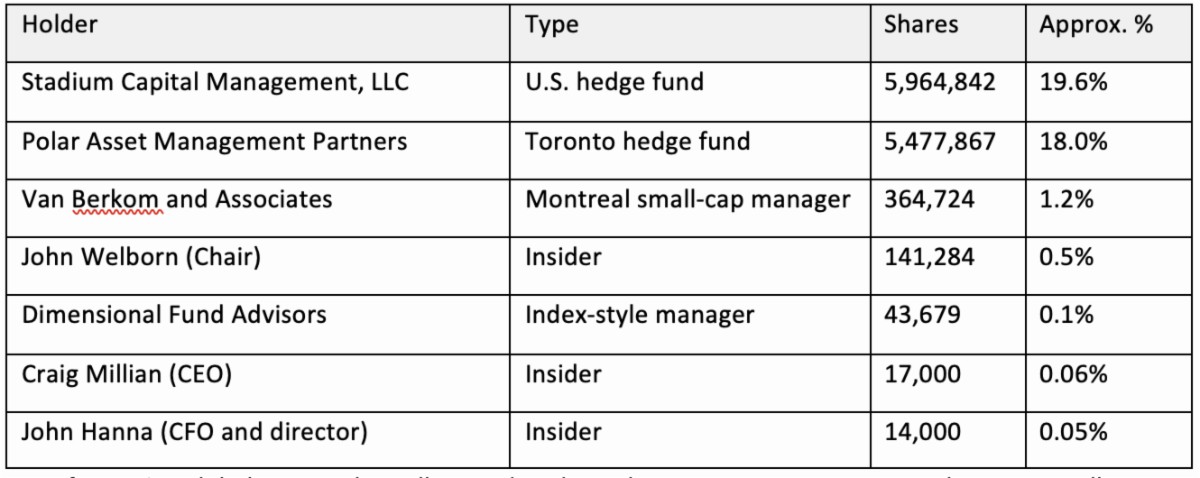
Data from S&P Global via Simply Wall St, updated October 2026. Percentages use about 30.4 million shares.
What this means for investors
- Two holders can steer the company. Stadium and Polar are long-term, engaged holders. HLS is Stadium’s largest position, at about 55% of its reported portfolio. Polar signed an agreement with HLS in 2023 that let it propose a director. Its nominee, John Hanna, joined the board and is now the CFO.
- A big seller could swamp the market. The stock traded only about 8,300 shares a day on average in the six months to May 2026. Either fund’s stake equals roughly three years of normal trading volume. If one decided to exit, the price could suffer. On the other hand, a buyer of the whole company would only need to deal with a few holders.
- The public float is small. HLS’s buyback filing implies a public float of about 18.7 million shares. The other ~40% sits with insiders and the two large holders.
- Other institutions are scarce. Outside the two hedge funds, institutions hold only about 1.4%. Mawer Investment Management held about 10% in 2023 but no longer appears among the top holders. Van Berkom raised its stake by about 47% recently.
Insider buying
Insiders have bought small amounts on the open market and reported no sales:
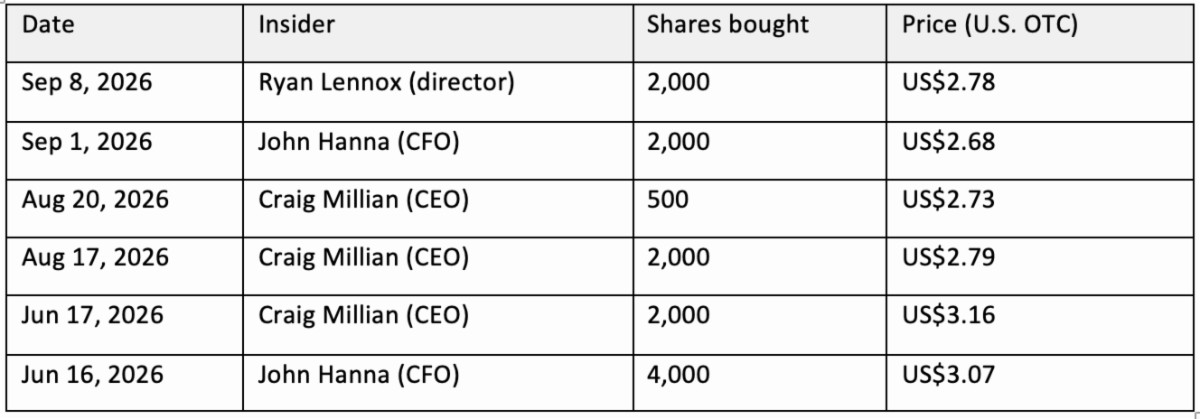
These buys show support, but the dollar amounts are small. The CEO’s total pay was about US$1.35 million; his share stake is worth well under C$100,000. Investors may want to see management own more.
Board changes
On October 1, 2026, directors Kyle Dempsey and Christine Elliott left the board. Elliott, a former Ontario Minister of Health, moved to a consulting role advising HLS on health policy and government relations. Two new independent directors joined: Dr. Linda Maxwell, a physician-executive who also sits on the boards of United Therapeutics and ImmunityBio, and Mark DeLong. The board has eight members, six of them independent. John Welborn chairs it. The stock fell 7.4% to C$3.89 that day, then recovered to C$4.33 by October 23.
Past mistakes and how HLS fixed them
HLS made a long list of mistakes, and shareholders paid for them. The stock fell about 70% in the five years to early 2026. Most of the damage came from three things: an oversold Vascepa launch, too much debt, and too much reliance on royalty income HLS did not control. The new team fixed the balance sheet first and has avoided repeating the old errors with NILEMDO. Here is the full list, newest first.
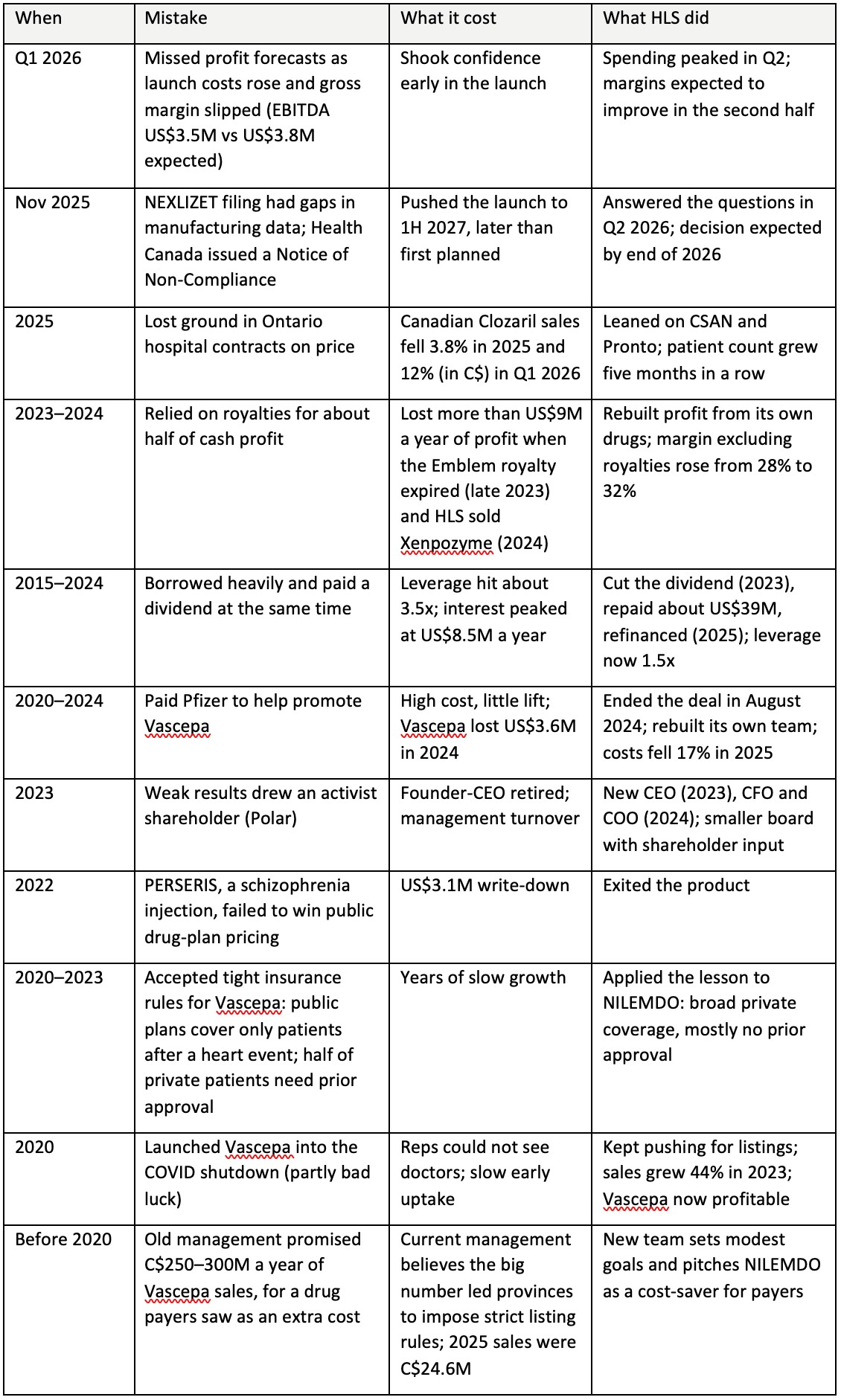
The lessons
- Promise less, deliver more. A huge sales target hurt Vascepa’s pricing talks. Management now gives modest goals: C$2 million of NILEMDO sales this year.
- Access drives launches. Vascepa’s slow start came mainly from insurance hurdles, not doctor demand. NILEMDO won broad private coverage with no prior approval within months.
- Own the sales team. The Pfizer deal cost too much. HLS’s own focused team grows Vascepa faster and cheaper, and now carries NILEMDO for almost no extra cost.
- Own your profit. Royalties vanished on someone else’s schedule. Today nearly all profit comes from HLS’s own drugs.
- Debt limits choices. With debt now modest, HLS can fund launches, buy back stock and look at deals at the same time.
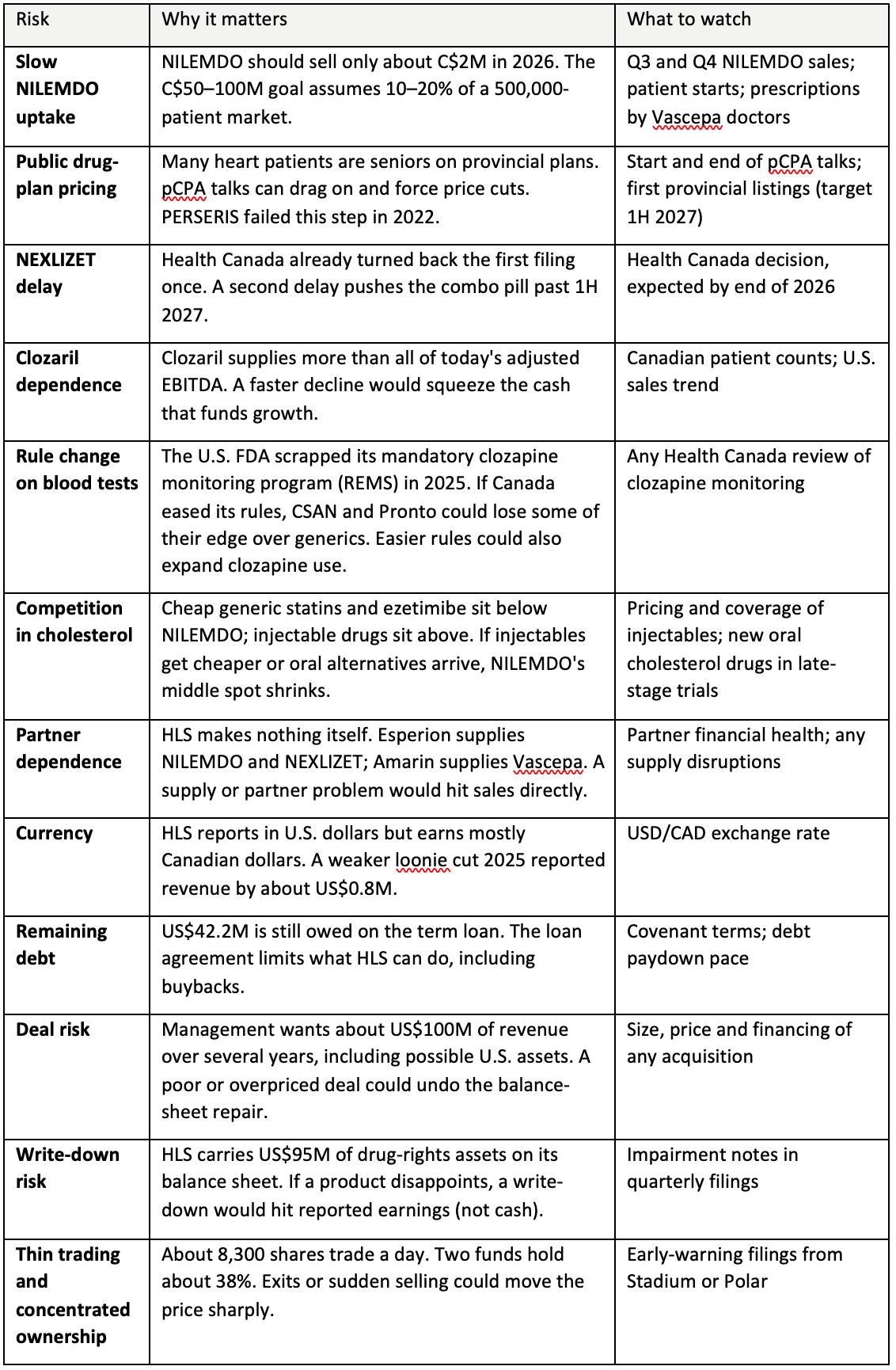
Current risks
The biggest risk is simple: the NILEMDO launch has to grow from a tiny base, fast. Almost everything else on this list either feeds that risk or sits under it.
Five questions for management AFTER THE QUARTERLY NEXT WEEK
These questions target the gaps that most affect what HLS could be worth: how long its products stay protected, how much it keeps from each sale, whether its sales channel can scale, whether Clozaril’s moat holds, and how it will spend its cash.
- Intellectual property and exclusivity. NILEMDO’s data protection runs to about late 2033, and your slides show patents to 2040. Which patents have you listed on Health Canada’s Patent Register for NILEMDO and NEXLIZET, and when does each expire? What protects Vascepa in Canada until 2039, given that U.S. generics arrived in 2020? Has any generic maker challenged these patents in Canada?
- Profit per pill. You expect about a 65% gross margin on NILEMDO. Will NEXLIZET match it, given that it adds ezetimibe? How does that margin change as sales pass each royalty tier? How much remains to be paid in milestones, and what triggers them?
- The sales channel. How many heart-drug reps do you have, and how many doctors do they reach? What share of NILEMDO prescriptions come from doctors who already prescribe Vascepa? At what sales level would you need to add reps or spend more on marketing?
- Clozaril’s moat. The U.S. FDA scrapped mandatory clozapine blood-test reporting in 2025. Is Health Canada reviewing its rules? How much of Clozaril’s roughly 50% share depends on CSAN and Pronto, and how would you defend that share if monitoring rules eased?
- Capital allocation and the US$100 million goal. How do you weigh buybacks against new product deals? What size of deal could you fund without issuing shares, and what debt level are you comfortable with? Would you buy a U.S. asset that needs its own sales force, or only products your Canadian teams can carry?
Estimates in this report: current share count, market value, enterprise value, the EV/EBITDA multiple, the cash-flow yield, Vascepa’s 2028 sales, and every figure in “The profit engine” are this report’s own estimates. They use about 1.38 Canadian dollars per U.S. dollar and about 30.3 million shares. The 2027–2028 cases rest on management’s targets (65% NILEMDO gross margin, low-teens Vascepa growth, C$50–100M peak) and sell-side analysts’ forecasts; they are illustrations, not predictions. Check them against the Q3 2026 results in mid-November.