
Articles
See All
The Little Data Center that MIGHT
CARRIER CONNECT DATA SOLUTIONS
CCDS stock chart has spent a long time doing…nothing. When you buy any junior stock, you have to appreciate there can be a long time between milestones/notable achievements that make a difference in a stock.
Data centers are a new PRIORITY business for the world, because of the very rapid rise in AI–and data centers are a contentious issue. CCDS has a focused strategy with some initial success, a focused CEO with lots of skin in the game, net cash and a tight share structure. So I wait…with the stock sitting right at my ACB between the two financings I bought.
There’s A LOT about data centers in the news almost every day now. Mostly due to my impatience, me and Claude AI sent CEO Mark Binns seven questions about empty space, pricing, margins, AI and money. He answered all of them. Here is what he said, what it adds up to, and what he still has to prove (I haven’t bot or sold any stock here for a long time).
Claude has made everything a little more dramatic than my regular style.
THE SHORT VERSION
CCDS has 7.7 MW of power today and less than half of it is sold. Binns says that is a timing issue from two sites, not a demand problem. He is now charging new AI customers about two and a half times what his older customers pay. And one AI client wants 25 MW — more than three times everything CCDS owns today. The upside is big. So is the job of paying for it.

First, what CCDS does
Carrier Connect buys small, older data centres that are already built and running. It rents rack space, power, cooling and network links to about 85 customers. It owns the gear. It leases the buildings.
Sites: Vancouver, Ottawa, Saint John (NB), Perth (Australia), and Rochester, New York, bought in August. Most customers today are ordinary businesses running ordinary computer work. As Binns put it, these sites “were around long before AI.”
The plan is simple to say. Buy old sites cheap. Fill the empty space with AI customers who pay much more. Then use the cash, stock and debt to buy or lease more.
Why is more than half the space empty?
This was my biggest worry. Empty space earns nothing, and 46% use is low for this business. Mature sites should run at 80% or more.
ASKED How many MW do you have live, what share is sold, and what do you charge?
Binns: We have about 7.7 MW today. It is heavily enterprise compute, not AI, as the DCs we bought were around long before AI. We are at 46% utilized in aggregate, but that’s because we just bought Rochester at 20% utilized, which we will be filling very quickly.
In a follow-up, Binns gave me the site-by-site picture:
• Rochester is on the bigger end and only 20% full. The landlord had only just started selling the space when CCDS took over. He says clients are bidding now for all of the rest.
• Perth is 15% full and has been since day one. But it makes money. CCDS is now taking bids for the balance.
• Every other site — Vancouver, Ottawa, Saint John — runs at high use, he says.
He also credits the Chief Revenue Officer hired in April with a very large sales funnel. And he gave a number for what the empty space could be worth: C$13 million to C$15 million a year in added revenue. He calls that conservative, because he does not expect to fill all of the open space with AI customers.
Does that number hold up? Here is my check. 7.7 MW less 46% sold leaves about 4.2 MW open. At the AI price of roughly C$4 million per MW per year (more on that below), 4.2 MW would be about C$17 million. So C$13–15 million assumes most, but not all, of the open space goes to AI at full price. The math works. Whether the customers show up is the part to watch.
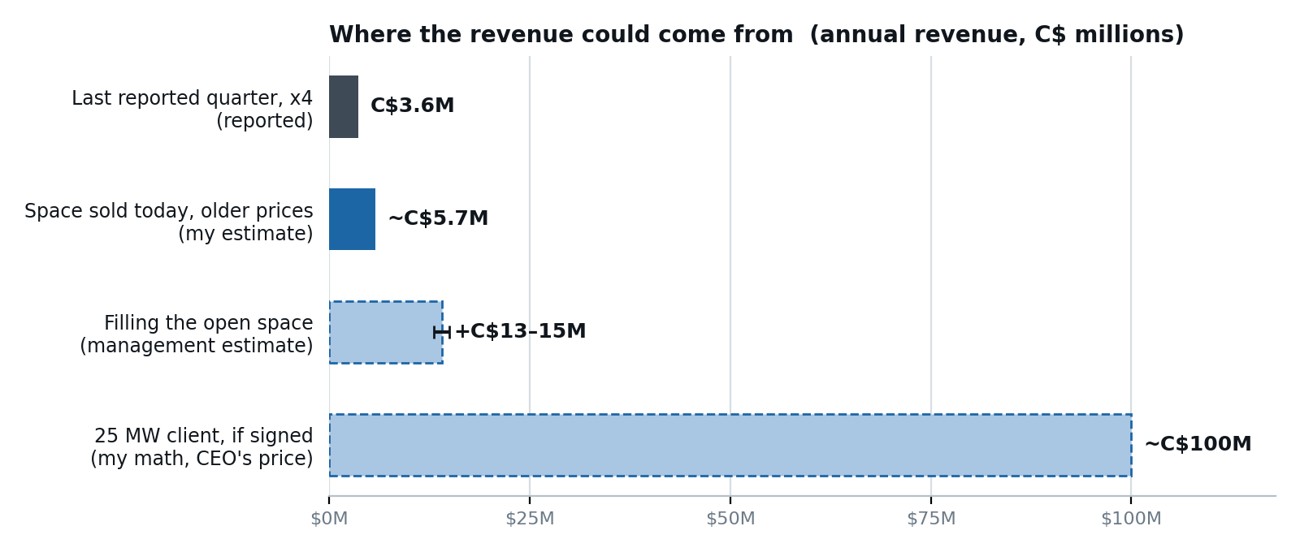
Reported: quarter to March 31, 2026 (C$910,000) times four. My estimate: 3.5 MW sold at the C$135,000 per MW per month Binns says older customers pay; not company guidance, and it includes Saint John and Rochester, which the last report did not. Open space: management’s estimate. 25 MW: my math at management’s C$4M per MW per year AI price, if the LOI became a full contract. Neither of the last two is booked revenue.
Look at the scale on that chart. The last reported quarter works out to about C$3.6 million a year. Filling the open space could add three to four times that. The 25 MW client alone would be worth roughly C$100 million a year. That is the whole bull case in one picture. It is also why the next two or three quarters matter so much. The bars at the bottom are forecasts, not sales.
Two Prices: Old Customers And New AI Customers
This is the most important new number in the report. CCDS charges very different prices to its legacy customers and its new AI customers.
ASKED What is your average revenue per kW, and how does that compare to new clients today?
Binns: Our historical customer base is paying for a mix of space and power, at CAD ~$135,000 / MW / month combined. For new AI customers, we charge USD $250,000 / MW / month. Pricing has moved up dramatically over the last couple of years.
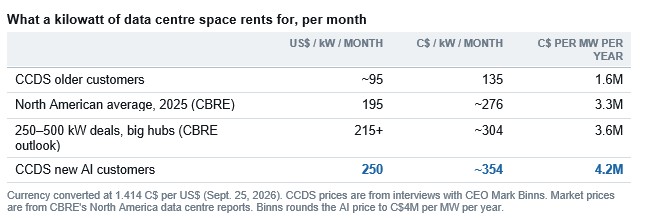
Two things jump out.
First, the older customers pay about half the market rate. That makes sense for small, older sites in smaller cities. But it also means there is room to raise prices as contracts come up for renewal. I did not ask about renewals. I will next time.
Second, the AI price is above the big-city market. US$250 per kW is about 15% to 30% above what CBRE reports for similar-size deals in major hubs. That is a strong price for older, air-cooled space in smaller markets. Binns says the market has moved up fast, and AI customers pay for power they can get now. The proof will be signed contracts at that price, showing up in revenue per MW.
The 25 MW customer
In July, CCDS announced a non-binding letter of intent for up to 25 MW of AI demand from one unnamed client. I asked where it would go, since CCDS only has 7.7 MW in total.
ASKED Where will you put 25 MW? How will you pay for it? What makes the LOI binding, and when?
Binns: We absolutely need to add capacity to house that 25 MW demand. Our total funnel is over 150 MW actually, so we have massive demand for space. We will be leasing existing or former DCs, matching our current DC lease model, but also be looking to buy built-out DCs, if the prices are right. The 25 MW LOI can become a contract at any time, as soon as we have space to put them into. The customer is ready and we are working to bring the needed supply into our portfolio.
ASKED Is this client real and operating, or a startup hoping to be?
Binns: Yes — one customer with global deployments already, looking to place 25 MW with us. They are absolutely operating now. We are just one of the places they are looking to place their infrastructure. Their demand is massive.
So the client is established and active. That lowers one risk. But note the last part: CCDS is one of the places this client is looking. The deal is not signed. The bottleneck is not demand. It is supply. CCDS has to find, lease or buy the space before the client puts its gear somewhere else.
That is a race, and CCDS is a small company in it. 25 MW is more than three times its whole network today.
How will they pay for all this?
ASKED How much cash is left? How will you pay for the next buys? What price per MW and payback do you set as a limit?
Binns: We have ~$6M in cash still. Every deal is different — we’ve used cash, stock, combination, and vendor take-backs. A common starting ground for buying is offering half cash, half stock. More commonly now the seller wants stock as they see the historical performance of our shares. We want to pay in the $3M / MW range, or less. We should be seeing payback in 3 years though it depends on site specifics. Our real goal on any DC acquisition is to pay 3x top line revenue or less, as the market values public DC portfolio companies at 10x+ top line. That’s a good business model.
On debt, Binns told me U.S. bank lenders will happily lend against a data centre, because they get a hard asset as security. So the tools are: cash, shares, seller financing, mortgages, and leases.
Cash has gone from C$9.9 million at March 31 to about C$6 million now. The Saint John and Rochester buys account for part of that. Six million dollars buys about two MW at his target price. It does not buy 25 MW. Anything big will mean more debt, more shares, or both.
MY MATH: IS A 3-YEAR PAYBACK REALISTIC?
Take a site bought at C$3 million per MW, fully sold, at the 40% long-term gross margin Binns targets:
Older prices: C$1.62M revenue x 40% = C$0.65M/yr -> ~4.6 years
AI prices: C$4.00M revenue x 40% = C$1.60M/yr -> ~1.9 years
So the 3-year goal depends on AI pricing and on filling the space. At old prices it takes longer. This is gross profit, before head office costs and upgrades, so real payback runs longer on both lines. For reference, Saint John cost about C$3.5 million per MW, a bit above his target.
On valuation, his point is fair in direction. Big public data centre owners do trade at high multiples of revenue. CCDS itself is valued at about C$37 million. That is roughly 10 times last reported revenue, or about 6.5 times my estimate of today’s run-rate. If CCDS buys at 3 times revenue, each deal should add value per share — as long as the price paid in new shares is not too low.
Sellers wanting stock is a good sign. It means they like the shares. But every share issued splits the pie a little more. Watch revenue per share, not just total revenue.
Margins: flat now, 40% later
ASKED Gross margin was about 32% last quarter. What do you expect once Saint John and Rochester are folded in, and in two years?
Binns: In the short term, I don’t expect much change in gross margins. Saint John is running at higher capacity so has better margins for now. Rochester is being filled up, but running lower capacity today, so tighter margins. They may cancel each other out short term. Long term we expect to see gross margins across the portfolio hit 40%.
That is a sensible, modest answer. Don’t expect margin gains in the next report. The move to 40% should come as Rochester and Perth fill, and as AI customers at higher prices make up more of the mix. (I kind of thought Perth would have filled up more by now.) Larger data centre companies run higher than that, so 40% is not a stretch target for the industry. It is a stretch for CCDS today.
Is it ready for AI? And does it own chips?
ASKED How many racks can take 15 kW or more? What would upgrades cost? Will you own GPUs?
Binns: All of our racks can handle 15 kW today. The issue is supply of power in our current DCs, which are mostly full outside of Perth and Rochester. The excess capacity there is being targeted to AI installations without further investment required. They are AI ready (air cooled). We purposely do not own GPUs. Our business model is colocation strictly, so we sell the space, power and cooling and let our customers bring their own GPU/CPUs.
This answer removed two risks I flagged last time.
No big upgrade bill. Binns says the open space in Perth and Rochester can take AI gear with no more spending. That is 15 kW per rack, air-cooled. It suits AI “inference” — running AI models for users. It is not the 100 kW-plus liquid-cooled racks used to train giant models. That is fine. Inference is the bigger, steadier market, and it is the one small sites can serve.
No chip risk. CCDS is a landlord, not a chip renter. Used Nvidia H100 prices fell about 85% from late 2023 to mid-2026. That loss lands on the customer, not on CCDS. The trade-off: CCDS gives up the higher per-hour income that chip owners can earn.
The market backdrop, briefly
Nothing here has changed since my September 21 report. Demand for data centre space is the tightest on record. CBRE put vacancy in the big North American markets at 1.4% in the first half of 2026. Rents for small deals rose 4% to 8% in six months. Power is the hard limit, and CCDS buys sites that already have power hooked up.
The cost gap is the core of the story. Building a new data centre now costs about US$11 million to US$18 million per MW. CCDS wants to buy running sites at C$3 million per MW or less. Even allowing for older gear and shorter building leases, that is a large discount.
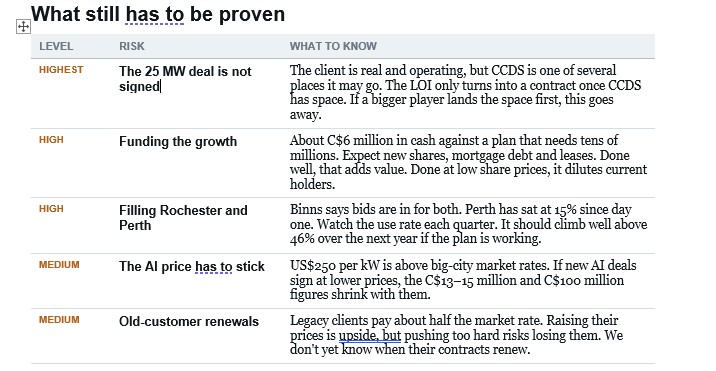

What to watch in the next two reports
CCDS’s fiscal year ended June 30. Annual results should be out by late October. That report will be the first to show a full quarter of Saint John. Rochester arrives in the one after.
• Use rate. Up from 46%, led by Rochester and Perth.
• Revenue per MW. Rising toward the AI price as new customers sign.
• Signed AI contracts. Any part of the 25 MW turning binding, and at what price.
• New space secured. Leases or purchases, the MW added, and the price per MW.
• How it is paid for. Shares issued, debt taken on, and revenue per share.
• Gross margin. Flat near 32% is fine for now. The trend to 40% is what counts.
The Bottom Line
Mark Binns answered every question directly, and the answers mostly hang together. The low use rate has a clear reason. The open space is AI-ready without new spending. CCDS does not carry chip risk. And the pricing gap between old and new customers is large enough to change the size of this company.
What changed most is my view of the bottleneck. It is not demand. Binns says the funnel is over 150 MW and one operating client wants 25 MW. The bottleneck is supply and money: finding space fast enough, and paying for it without giving away too much of the company.
This is still a small, early-stage roll-up. The next two quarterly reports will show whether the open space fills at AI prices. If it does, CCDS earns the right to grow much bigger. If it doesn’t, you own a small, profitable collection of older data centres at a fair price — with a lot of promises attached.
Management answers are from Mark Binns’ written responses to my questions (September 22, 2026) and a follow-up (September 2026), lightly edited for typos. They are the company’s views and forecasts and have not been audited. Other sources: Carrier Connect Data Solutions news releases (Jan. to Aug. 2026) and Q3 fiscal 2026 results; CBRE North America Data Center Trends H1 2026 and H2 2025; Cushman & Wakefield 2026 Data Center Development Cost Guide; GPU price trackers (Sept. 2026). Share price is the Sept. 25, 2026 OTCQB close for CCDSF, converted at 1.414 C$ per US$; market value is approximate.
Disclosure: I own shares of Carrier Connect Data Solutions. This report is for information only. It is not investment advice, and it is not a recommendation to buy or sell any security. Check the company’s filings on SEDAR+ before you make any decision, and size any position to what you can afford to lose.