
Articles
See All
STINGRAY’S STOCK COULD BE MUZAK TO INVESTOR EARS (RAY – TSX)

QUICK FACTS
Trading Symbols: RAY
Share Price Today: $15.50
Shares Outstanding: 68 million
Market Capitalization: $1,054 million
Cash: $22 million
Debt: $569 million
Enterprise Value: $1,602 million
IS THIS A GROWTH STORY OR WHAT?
The market is expensive. But many stocks are not. All you have to do is look past the AI trade and there are opportunities out there.
Stingray (RAY – TSX) is one I’m looking at. Here is a stock that has a bunch of things going for it. It’s cheap. It’s growing. It even pays a dividend (2.2%, not a lot, but it’s there). I go into a lot of background here before I hit the big growth angle, but I think that will help you understand the trade before us.
Let’s start with cheap. At 15.50 the stock is trading at 11x earnings and 11x free cash flow.
When a stock is that cheap there is usually a reason for it–which I thought that would be the case.
In fact, I went into this skeptical. I know the name Stingray from cable television. Canadians might remember when every cable package came with a number of free music channels branded as Stingray music (and Galaxie Music before that).
If that was the go-to business today, the low-double digit multiple would make sense. But it isn’t. It is part of the equation but not the growth part. And there are far more interesting elements to Stingray with a real chance at continued growth.
Stingray has evolved from cable TV music to streaming. They are the anti-SiriusXM, offering free music channels where they collect on advertising.
What’s surprising is that they are virtually the only company doing programmatic audio ads. That is letting them grow out this niche profitably.
None of this appears to be priced into the stock. The combination of Stingray’s name – I mean how many others see that name and think free cable music channels, and years of a basically flat stock price – and quite honestly, no one looking at the name because it’s NOT AI.
That could be a mistake. Stingray could turn out to be a sleeper.
A NEW ROLL-UP ON AN OLD ROLL-UP
Stingray is a roll up story with a 20-year history. It is worth taking a few minutes to unpack it to understand where the stock is today, why it is overlooked and why it may be worth a lot more.
Their founding business was a karaoke catalog called Sound Choice, which was purchased in 2007. They bought a few other small businesses along the same lines. But their big splash was in 2019 when they got into TV-audio channels.
In 2009 Stingray picked up Max Trax from Corus and then Galaxie, the CBC’s pay-audio service. Both were collections of cable TV audio networks. If you are Canadian you almost certainly remember Galaxie – the music channels up in the high numbers.
Like me you may have assumed Galaxie was replaced by something new when the Stingray music channels came along. But it was only a name-change and a new owner.
These deals turned out to be a template. Buy cheap audio content and sell it through subscriptions with the cable operators. Stingray did a dozen other deals in the next 6 years, acquiring pay-TV music channels in other countries.
It was a genuinely good business. Also a boring one with little growth. When the stock IPO’d the market treated it accordingly.
After going public in June 2015, the stock did a quick run from $6.25 to $8. But that was it. For the next 6 years the stock did nothing.
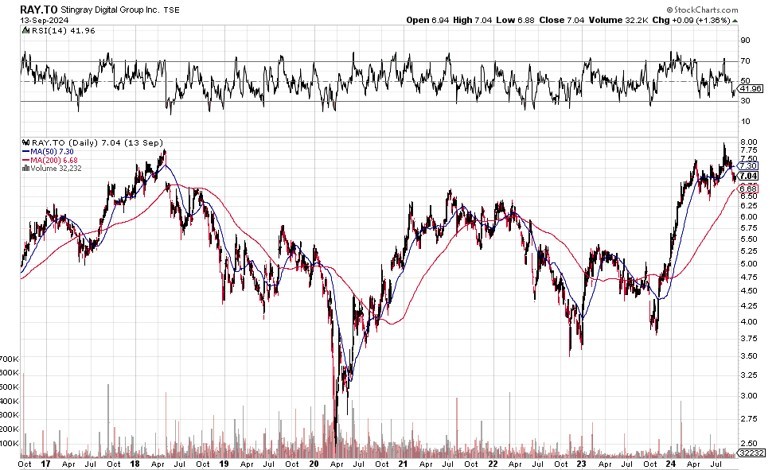
Source: Stockcharts.com
To understand why, just think about what they owned: pay-TV music channels from Galaxie and a bunch of international equivalent stations. A Commercial Music business that offered what was basically Musak, a term that is synonymous now with background music, hold music, and the music you would hear at the supermarket.
These businesses are still around today. While Stingray doesn’t break-out the revenue, the pay-TV channels are pulling in around $60-$80 million of revenue a year. The Commercial Music subscription business is in the $80-$100 million range. Stingray as a whole did $460 million last year, so these are still valuable pieces.
However, growth-wise these businesses are flat. Worse, with a dependence on cable subscribers, cable-TV is a poster child for a melting ice cube.
Unfortunately, rather than recognize the issue early, Stringray made a bad situation worse. They pivoted into broadcast radio with the acquisition of Newcap Radio in 2018.
Those stations, which are still there and rebranded as Stingray Radio, generate around $130 million of revenue and $40 million of EBITDA. But same story as before – they are zero growth.
You can see what was going on here, and why the stock was not going anywhere. Stingray was labeled a value trap–for good reason.
A STREAMING AUDIO JUGGERNAUT?
Flash forward to today we can see that Stingray is actually doing something similar to what it did 15 years ago. But with the learned lesson–to not buy stuff that isn’t growing.
The theme though has a very similar ring to it – it is audio, but this time its streaming.
The ironic part is that the pivot began with the one business they didn’t acquire, called Free Ad-Supported Streaming Television, or FAST for short.
FAST is a set of curated music and ambient channels like Cozy Café and Stargaze.
If you think that sounds like Stringray Music, it does.
The FAST platform was born out of the legacy TV subscription audio channels. Stingray launched the business in 2019 and found willing partners in the SmartTV operators like Samsung and Roku and free-TV providers like Pluto.
The difference is that they are distributed for free on streaming platforms, mostly SmartTVs like Samsung TV Plus, Roku Channel, Pluto TV, LG Channels, Plex, Vizio WatchFree+.
Unlike the cable television channels, Stingray isn’t paid by operators with subscriptions. Stingray gets paid by running ads on the stream and splitting the revenue with the platform.
FAST is growing fast. Revenue was up almost 70% last quarter. Stingray doesn’t break out revenue for the segment (this is going to come up again and again) but we can triangulate it in the area of $70-90 million.
Margins are also high, I’d peg them north of 50%.
So why is FAST growing like it is? I think the answer lies in “ambient” and “free”.
These stations are not active listens like a podcast, audiobook or even Spotify playlist. You can put them on in the background, and you pay nothing to do so.
It also helps that connected TV advertising has been rising as a whole, at 15-25% annually.
Third, they are expanding to more devices. In 2026 the adds are significant: 13 channels on JioTV in India (February), 12 channels on Whale TV+ across Latin America and Western Europe (February), 17 channels on OrkaTV in the US (April), 9 channels on Titan OS across European Philips/AOC/JVC/Sharp TVs (July), plus launches on Hisense TVs. Before that, 29 new channels on Amazon Fire TV, new channels on TCLtv+ and Roku.
Stingray must have figured they were onto something with FAST. And much like they did some 15 years before, they decided to double down.
Which is what led them to the acquisition of TuneIn.
TUNEIN – ADDING SUBSCRIBERS, AD INVENTORY AND BREADTH
Stingray acquired TuneIn last year.
TuneIn is a streaming service of its own, focusing on AM/FM and internet radio.
Like FAST, TuneIn is free radio. They make money by inserting audio ads into the streaming radio broadcasts. And like FAST, the TuneIn app is primarily used via SmartTV platforms, and some car infotainment systems and as a standalone app.
At the time of acquisition, TuneIn was forecast to do US$110 million of revenue and US$30 million of adjusted EBITDA for calendar 2025. It had about 75 million listeners at the time of the acquisition.
I don’t think TuneIn is growing like FAST is. There isn’t official disclosure on revenue trends (that again) but there are comments from TuneIn’s former CEO Rich Stern going back as far as 2022 that revenue then was over $100 million.
In other words, it is not much different 3 years later.
But while Stingray bought a zero-growth asset, they didn’t pay a lot for it. The TuneIn acquisition was completed for just 5.8x EV/EBITDA.
And what it brought was a platform of users and a customer base looking to buy audio ad space.
STINGRAY PREMIUM AD NETWORK
The Stingray Premium Ad Network is more often called “backfill”. It gets the name because it is backfilling empty ad slots with ads.
This is the newest of the three streaming businesses; it was introduced in June 2025.
It is also experiencing a hockey stick on the growth curve.
On the last conference call, CEO Eric Boyko said that backfill was “huge” and doing US$200,000 per day. That’s a run rate of C$100 million a year.
Two quarters ago Boyko said that backfill was doing $25-$30 million. In June it was doing $90 million.
That means the business has been expanding at a phenomenal rate – 8x in a couple quarters!
How is it growing so fast?
What SmartTV vendors like Vizio, LG, and Samsung have surplus of is airtime their own sales teams can’t sell.
The airtime comes from the apps on their platform. These vendors typically negotiate a cut of ad inventory in apps distributed on their operating systems.
They also are selling ad-space for screensaver ads, app-store promotions, home-screen banners.
Stingray provides a sales outlet for the slots they can’t sell.
It works something like this. A SmartTV provider like Samsung is trying to sell all its slots, banners, screensavers, the works. And it can sell some at the price it wants. But it usually can’t find buyers for all of it.
If they tried to liquidate it all, the clearing price for the marginal slot would be lower, maybe a lot lower, then they would like.
Exposing that price to customers would give customers a bargaining chip. So instead, the providers siphon off the unsold space to Stingray.
Stingray acts as principal in this transaction. They are actually buying the ad space from the vendor and then looking for someone to sell it to.
Stingray can sell that space under a different label and therefore they can do it at a lower price. And they have a network of buyers from the TuneIn acquisition that are looking to buy.
Stingray partners with 25 OEM platforms on the TV side. The big 3, and most important by some margin, are Samsung, Visio and LG.
It wasn’t until Q1 that the OEMs began rolling out audio ads to Stingray. Up until then the business was space like banners and home screens.
That is the big increase that Stingray saw during January to March. It moderated in their last fiscal quarter.
This doesn’t include the TuneIn stations. When TuneIn streams an iHeart radio broadcast for example, the ad slot belongs to iHeart. TuneIn gets revenue share. But the ad itself is coming from somewhere else.
Margins are low, in the mid-20 gross margin range because they are selling the space that is less attractive. But if the CEO remarks on the last call are to be believed, and there is no reason not to, then this business just compounded at 8x in the last 180 days. Which is quite the feat!
GROWTH AND DEBT
Like you’d expect from a serial acquirer, Stingray has a lot of debt.
They have a drawn credit facility of $569.5 million against cash of just $21.9 million.
A big part of that is recent. When they acquired TuneIn in November 2025 they added a $150 million term loan to do so.
Stingray has a dual-class structure (multiple voting shares carry 10 votes while the subordinate voting shares are what trades). Boyko controls roughly 57% of the votes while holding about 21% of the shares.
That is normally enough to make me stop looking. HOWEVER, Stingray MUST be Canadian controlled, like AirCanada–AC has two classes of stock. Stingray has to have this as well. This is legal, not by choice.
Separating organic growth from acquisitions is a challenge. They have been growing in the low teens though that accelerated significantly with the backfill surge in Q2.
Source: Stingray Financials
We don’t know exactly how much TuneIn contributed to the fiscal 2026 results. But the acquisition closed December 19th, 2025, which is about 3.5 months of the fiscal year. Seasonally that is the worst 3.5 months of the fiscal year so definitely a weak period.
TuneIn was forecast to do about US$110 million of revenue in calendar 2025. If you sort of work forward from that and assume 22-23% of revenue is in the seasonally weak Jan-Mar period, and then another C$5 million of revenue in the last half of December, you come up with around C$40 million for the entire 3.5 months, less a reclassification of C$13.8 million.
Stingray also acquired Singing Machine in mid 2025, another karaoke business, but Singing Machine revenue’s look to be quite small,
Tallying it up, we have TuneIn revenue of $25-$30 million, which puts the growth rate without TuneIn at about 11%. About inline with other years.
Growth has been steady. But what happened in Q2 is on another level. Boyko said on the call that growth was 27% year-over-year in Q2. Though that is largely due to the hockey stick of backfill, which may or may not be a one-time move.
PUTTING IT TOGETHER
What Stingray is aiming for is dominant audio player for streaming on connected devices.
My kneejerk response to that was, isn’t that what Sirius XM is?
But not really. In fact it is the opposite. SiriusXM is using exclusive and expensive content (like Howard Stern, the NFL) to sell subscriptions at $15-$25 per month.
Stingray is deliberately taking commodity content, playlists and radio simucasts without anything exclusive and giving it to customers for free. In return you listen to some commercials. Its like, well, radio.
The FAST channels give them a large inventory of ad space. TuneIn is bringing in an audience of 75 million listeners for their audio app. TuneIn is also bringing its advertiser relationships. The Premium Ad Network lets them connect buyers and sellers.
If you take another step back. it is actually not that different than what they did 20 years ago with the original Stingray Music. There they bought neglected music content cheap, pushed it through other people’s distribution like cable operators, and took a take for it. They just changed the medium – to streaming SmartTVs.
Maybe most important for the stock, they seem to have caught lightning in a bottle with the Premium Ad Network. I am not sure how long this sort of growth can last, but even what they have had is not really in the stock.
FAST is growing at 70% year-over-year. The Premium Ad Network growing at an otherworldly 8x in the last half a year. Overall, the entire business pro-forma was growing at 27% organically last quarter.
I’m not sure if that level of growth can continue. But it will at some level, and that doesn’t seem be priced into the stock at just a little over 10x earnings.